Interview help

Interviews can be a stressful and unnerving experience for most people.

We want to help make the process as painless as possible, so we’ve come up with some helpful hints and tips to remember.

Are you right for the job?

Before writing your application form you should look carefully at both the job outline and the employee specification to determine:

  • What qualifications are essential for the role (if any)
  • What specific skills and knowledge are required to do the job
  • What qualifications, skills and knowledge you have which are relevant
  • Do you meet all the essential criteria? Read about the importance of this below.
Meeting the 'essential criteria'

Your application form needs to demonstrate how you meet ALL of the ‘essential criteria’ from the ‘employee specification’ section of the job listing.

This essential criteria acts as a checklist that the recruiting manager uses to determine if you can be shortlisted for an interview. You must therefore provide working examples for each essential criteria if you want to be invited for an interview.

For example, imagine one of the essential criteria is ‘Experience of delivering training’. Instead of just writing:

'I have experience in providing training to new team members.'

you could make this better by writing:

'I have actively been involved in training new team members, including the creation of a training guide which is used to assist with practical training. This guide is now regularly referred to by all staff, encouraging and promoting skill and knowledge retention.'

Education and qualifications

Contrary to popular belief, you don’t have to list every educational achievement and qualification you have obtained dating back to the beginning of your education. You should however, list all of your education and qualifications that are relevant to the specific vacancy for which you are applying, ensuring you detail any qualifications requested in the essential criteria.

Employment History

Employment history often plays an important part in your application form, especially where the vacancy you are applying for asks for previous experience. It can be a gruelling task to list every job you’ve held over the years and trying to remember every task you were responsible for can be difficult. We’ve put together a few helpful tips to try and make the task easier:

  • List your employment history in reverse chronological order (most recent first and work backwards).
  • If you can’t remember the specific date of your previous employment, just giving the month and year is fine.
  • Any gaps in employment should be fully explained. If you had a gap year, make sure to give the details such as where you went, what you did, who organised it, who funded it and what skills you think you learned as a result of the experience.
  • Try to think about how your gap year, or career break, made you more employable in relation to the job you are applying for.
  • When listing what your job responsibilities were in your previous employment, rather than try to list every duty you had, just emphasise a few key and transferable skills that are most relevant for the job you are applying for.
  • If your employment history is limited, include details of any part-time, temporary, voluntary or work experience you’ve had; especially anything relevant to the job you’re applying for.
References

All new starters to the council are required to have two satisfactory references, one of which should be from your current or most recent employer. To avoid delays later down the line if you are successful, please ensure that you provide accurate referee information in your application form. This should include their:

  • Full name
  • Preferred email address
  • Full postal address, including postcode

Always ensure that you have informed the people you choose as referees to avoid any issues. Although we won’t request your references at the application stage, if you are successful at interview, references will be sought as soon as possible.

Supporting statement - skills, knowledge and experience

When you’re very enthusiastic about applying for a job, it can be easy to get carried away writing a lengthy supporting statement. But it’s important to remember that when shortlisting, managers are only looking for people who can demonstrate the relevant and essential skills needed for the specific job.

So, whilst you may think it a positive thing to write five pages about your wide range of skills and experience, it isn’t an effective use of your time and will not guarantee you an interview.

Here are some hints and tips to help you write the best supporting statement you can:

  • Your supporting statement is the opportunity to sell yourself, so make sure to mention your achievements, knowledge and strengths.
  • Keep the information concise and well structured. Anything you write about needs to be relevant to the job you are applying for so keep it to the point.
  • Give key examples from your previous and current job roles that clearly demonstrate how you meet the criteria for the job.
  • Explain why you want to be considered for the job. This won’t have any bearing on whether or not you are shortlisted but it will demonstrate your passion and enthusiasm for the role.
  • Explain what you could bring to the role if you were appointed.

Your writing style can help to make your application stand out and demonstrate confidence:

  • The use of positive words and power verbs (in moderation), such as ‘effective, motivated, delivered, achieved, transformed, determined etc.’ will help to improve its quality.
  • Explain your relevant skills, knowledge and experience with concise paragraphs and avoid waffle or vague statements.
  • If it helps, use bullet points and sub-headings to make your statement easier to read.

This goes without saying but always check your application form before submitting it - especially your spelling and grammar.

If it helps, ask someone else to check it for you, sometimes they can pick up on things you don’t see.

Application FAQs

We’ve listed some of the more common questions we get asked about job vacancies. If we haven’t answered your question, please .

I have seen a job I am interested in can you give me more information about the position?

The quickest and best way to get more information about a job is to contact the manager whose details should be stated on the advert.

If there isn’t a name and contact details, please get in touch, and we will find somebody to contact you.

I am looking for a specific job relating to my own skills and experience, can you advise me if there are any vacancies available that you think would be suitable for me?

At this time we do not offer a job/skills matching service and would advise that you use the search facility on the jobs page to look for specific job types. You can search for specific jobs via category or by keywords.

You may also find it useful looking at our careers page, which shows the types of careers available at the council. Please note though that these aren’t current vacancies, and are only to illustrate the varying careers we have at the council.

I’ve been told that a specific job vacancy is coming up but I can’t see it on your website. Do you know when it will be advertised?

Unfortunately, we’re unable to provide any details of jobs which aren’t yet advertised. In this instance we would advise that you regularly check the jobs page to make sure you see the job as soon as it is advertised.

I’ve forgotten my username. What should I do?

Your username is normally your email address. If this doesn’t work, please and we can help you.

I’ve forgotten my password. What should I do?

Use the ‘forgotten password’ link on the login screen. You should receive an email within 15 minutes containing a reset link. Please do not press the ‘forgotten password’ button multiple times - this will not speed up the delivery of the email.

If you don’t receive it within 15 minutes, please try the link again.

If it still doesn't come, please .

It is the weekend, I am having issues logging in to the job’s website and a vacancy I’m interested in closes on Sunday evening. I am unable to complete my application on time, what can I do?

Closing dates are generally not changeable unless in exceptional circumstances. If you’re unable to access your account to complete and submit your application, please straight away on Monday morning. We may be able to contact the recruiting manager to see if they will accept a late application due to the circumstances.

I’m already an employee of the council and completing an online application but I can’t see the ‘previous employment’ or ‘qualifications’ section. Is something wrong with the form?

If you’ve noticed there isn’t a ‘previous employment’ or ‘qualifications’ section on the application form this means you are logged in using your council ESS (iTrent) login details. Logging in with these details, rather than with an account you’ve set up at home with a non-eastriding email address, means you won’t have to complete a separate employment or qualifications section on the form. However, you should ensure that any qualifications and experience you have that is relevant to the job you are applying for, is stated in your supporting statement, otherwise the vacancy manager will not be made aware of them.


Ready to apply?

A couple of things to note before you fill in your online application:

  • Adverts close at midnight on the closing date.
  • Data such as personal information and employment history will save when you submit an application form and then pre-fill into the next application form you complete.
  • Free text fields such as ‘skills, knowledge and experience’ page will not be saved and you must re-enter these with each application.
  • Symbols and special characters, such as è or &, must not be used as unfortunately, these can corrupt the data in your application form.
  • You must complete all mandatory fields marked with *.
  • If you are likely to complete several application forms for different vacancies, it can save time to prepare your supporting statement in a Word or notepad document. You can then copy and paste the relevant information into the application form when you are ready.
  • Before you begin, it will save you some time if you have the following information to hand:
    • Your National Insurance number
    • Details of your employment history
    • Your qualifications
    • Referee contact details

East Riding Pension Fund

Make a real impact on people’s futures by joining our dynamic, forward-thinking pensions team.

View vacancies

About the Team

The Team

East Riding Pension Fund, based in Goole, is responsible for administering the Local Government Pension Scheme (LGPS) on behalf of more than 340 employers and supporting over 130,000 members.

Our recently restructured administration team of 75 dedicated professionals is committed to delivering an outstanding pensions administration service to members, employers, and other stakeholders, and are constantly striving to improve and innovate our service delivery.

Liz

Head of Pensions

Lisa

Assistant Pensions Manager

Lindsey

Assistant Pensions Manager

Who are we?

Be INspired by our teams

Member Services Team

The team, led by Principal Pensions Officer Samantha, is responsible for calculating benefit entitlements for members leaving the scheme.

  • Benefit calculations before and at retirement.
  • Processing incoming and outgoing transfer payments.
  • Calculating benefits for the dependants of deceased members.

Digital Services Team

The team, led by Principal Pensions Officer Paul, oversees the development, maintenance, and optimisation of the Universal Pensions Management (UPM) system.

  • Designing and implementing automation within administration processes.
  • Writing reports, validations, and tools to identify members affected by data issues.
  • Supporting employers using the Employer Portal and assisting members with access to ERPFMSS, the member self-service portal.

Financial Control Team

The team, led by Principal Pensions Officer Pete, is responsible for managing monthly, quarterly, annual, and triennial financial events.

  • Monitoring, collecting, and reconciling payments from scheme employers for employee and employer contributions.
  • Other rechargeable amounts due to ERPF.
  • Making all pension payments to ERPF pensioners.

Member Data Services Team

The team, led by Principal Pensions Officer Christine, plays a central role in maintaining accurate active member data.

  • Managing Monthly Data Collection from employers.
  • Calculating benefit entitlements for members leaving the scheme before age 55.
  • Submitting accurate member data for the triennial valuation.
  • Conducting ongoing data cleansing activities to maintain accurate data
  • Calculating data scores for the Pensions Regulator.

Governance and Compliance Team

The team, led by Principal Pensions Officer Jane, ensures the Fund operates in line with legislation, regulations, and best practice.

  • Producing compliance materials.
  • Training content.
  • Providing technical support through interpretation of relevant regulations for both of scheme employers and fund officers.

Working for us

There's more to working at East Riding of Yorkshire Council than you might think.

Location

If you don't like being stuck in traffic East Riding is the place for you. We have beautiful locations without the typical city rush hour traffic. Many of our staff who have relocated here comment on how amazing working in the East Riding is.

Check out more About the East Riding

Flexible working

We can support you and the needs of your own family and things that matter to you. From full time, to part time, to a range of flexible working we are happy to talk to you about our range of options before you submit your application form.

Management support

We aim to provide a workplace where everyone feels supported and empowered. Our management is accessible and invested in employee growth, offering regular feedback and skill development opportunities.

Development

We help team members reach their potential through learning opportunities, on-the-job development, and skills-building for long-term career growth. Whether you aim to deepen your expertise, take on new tasks, or move into senior roles, we provide the guidance and resources you need.

Equipped

You will be fully enabled through mobile kit to work in a highly agile way at locations across the area.

Benefits at a glance

  • Staff discounts, generous pension and health and wellbeing schemes.
  • A friendly and supportive working environment.
  • Strong management support at all levels.
  • Flexible and hybrid working opportunities.
  • Generous annual leave entitlement.
  • Goole’s well connected location, is situated just 16 miles from Doncaster, 19 miles from York, and 29 miles from Hull, which makes it an ideal work base for people living across the surrounding area.
  • Make a positive difference to the area and the people living here.
  • Access to a local government pension scheme, staff discount and health and wellbeing schemes, car lease and salary sacrifice schemes and contribution to mileage costs

View all benefits

More about us

Service Area Information.

The East Riding Pension Fund, created following Local Government reorganisation in April 1996, administers the Local Government Pension Scheme (LGPS) for the four unitary Authorities in the region plus over 300 other local employers and organisations. It has a membership of more than 110,000 active, deferred and pensioner members.

Working in a pensions service means making a real difference in people’s lives every day. It’s a role rooted in purpose, helping residents plan for financial security, navigate important life changes, and feel confident about their future. Pensions often shape the quality-of-life people experience in retirement, so the guidance and support provided can have a profound impact on individuals, families, and the wider community.

We take our role seriously, ensuring that people receive clear information, timely support, and fair access to their entitlements, a pensions service becomes a trusted lifeline, offering reassurance, dignity, and stability at some of the most significant moments in a person’s life. It’s meaningful work that helps build stronger, more resilient communities, one resident at a time.

Who are we

With over 600 services and 12,000+ staff, we deliver a range of quality services to over 360,000 households within East Riding of Yorkshire. Please select the links below for further information.

Our future

Through our strategic workforce we’re committed to the delivery of some key strategies to achieve our ambitions of being a modern workforce in a modern workplace. Please see links and documents below for further information:

About East Riding of Yorkshire Council

If there was one phase to sum up the true spirit of the East Riding of Yorkshire and its council, it would be continuous ambition. We want to help and sustain our residents throughout their lives, and our approach is characterised by the traditional qualities that make this part of the country great, like hard graft, reliability, practical good sense and putting others first.

Our Values and how we work together as a team

East Riding of Yorkshire Council has a simple and powerful vision for the East Riding: Your East Riding… where everyone matters

To deliver our Vision, we have five corporate priorities, which include:

  • Growing the economy
  • Helping children and young people achieve
  • Empowering and Supporting Communities
  • Protecting the vulnerable
  • Valuing the environment

To support delivery against these priorities, we have a set of corporate Values, which drive the way we do things and shape our services. It is the responsibility of Members and staff to uphold the values of our organisation, which are:

  • Quality – We work together to provide the best services possible
  • Pride – We are proud of what we do and we positively embrace change
  • Respect – We treat people fairly and are open, honest and lead by example

Where is the East Riding of Yorkshire Council?

The East Riding is a hidden gem – it’s a great place to live, work and do business, with lots of potential and opportunities. It has many unique characteristics and a wide range of built and natural assets such as the varied coastline – which includes some of the highest cliffs in England and home to unique seabird colonies, to some of the lowest lying and fastest eroding – together with beautiful countryside, historic parishes and busy market town high streets with quality shops and restaurants. All of which is in close proximity and connected to the two historic cities of York and Hull and the Humber estuary providing huge opportunities to drive further ongoing economic growth in the area, especially in the field of zero net carbon reduction and green energy provision.

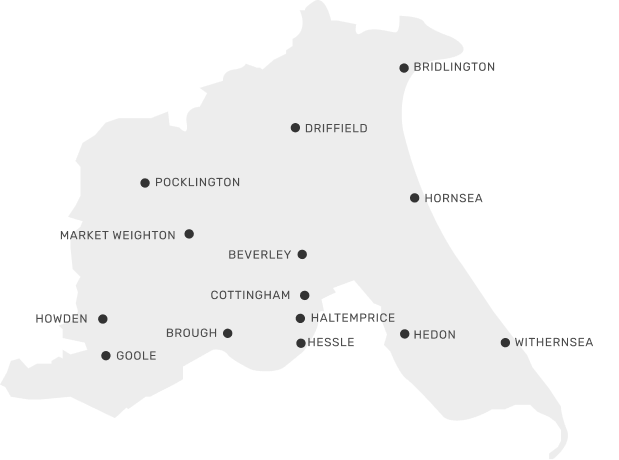
The Pensions Section is based at our Council offices in Goole, a vibrant and fast-growing town in East Yorkshire, offering an appealing blend of affordability, great transport links and a unique local character. Known as the UK’s most inland port, Goole has a fascinating industrial heritage and a distinctive skyline marked by its iconic “Salt and Pepper Pot” water towers. The town is surrounded by beautiful countryside, with nearby nature reserves which provide peaceful green spaces and excellent wildlife-spotting opportunities. Alongside its historic docks and waterways, Goole offers a welcoming town centre with shops, cafes,

leisure facilities, and strong transport connections via the M62 and rail links, making commuting and exploring the wider region easy and convenient.

We are one of the largest local authorities by area in the country covering almost 1,000 square miles. Our area reaches out close to York at the northern point and the North Yorkshire Moors when moving North East embracing 75 kilometres of coast from Flamborough in the North East to Spurn Point at the mouth of the Humber Estuary.

We boarder on to Hull and then our area including the iconic Humber Bridge moves West including Goole to our boundary with Pollington running North up the River Derwent towards York. In terms of commuting, Goole is an ideal work base location for surrounding areas; travel time from Doncaster to Goole is approximately 32 minutes via the M18, Hull to Goole is approximately 46 minutes via A63/M62, Selby to Goole is approximately 25 minutes and Scunthorpe to Goole is approximately 30 minutes.

The East Riding has many hidden gems and is a great place to live, work and have fun.

About the area

The East Riding of Yorkshire is arguably one of England's most beautiful counties - and one of its best-kept secrets. It is a landscape of diversity and contrasts with wide-open plains, rolling hills and wild and rugged coastlines combining to create an enviable living environment.

Quality of life in the East Riding is exceptionally high - housing is plentiful and prices are lower than many other parts of the country, yet the region can offer superb urban, rural and coastal locations. Most of our schools perform well above the national SAT and GCSE standards. Because of our commitment to rural schools, we can ensure that education is both accessible and local. Also, we have two universities on our doorstep - Hull and York.

Despite its beautiful rural location, the East Riding is connected to the UK motorway network by the M62 and to Europe by North Sea Ferries and Humberside Airport. Major cities such as Hull, York and Leeds are within easy reach, as is the beautiful historic town of Beverley. The seaside resorts of Bridlington, Hornsea and Withernsea and the natural beauty spots of the Yorkshire Dales and the North Yorkshire Moors are also right on our doorstep. The area boasts a racecourse at Beverley, as well as the country's oldest horse race - the Kiplingcotes Derby at South Dalton, and historic sites such as the Beverley Minster and beautiful beaches.

We're sure that if you choose to work and live in the East Riding, your stay will be a happy one!

Vacancies

Discover why the council is a great place to work